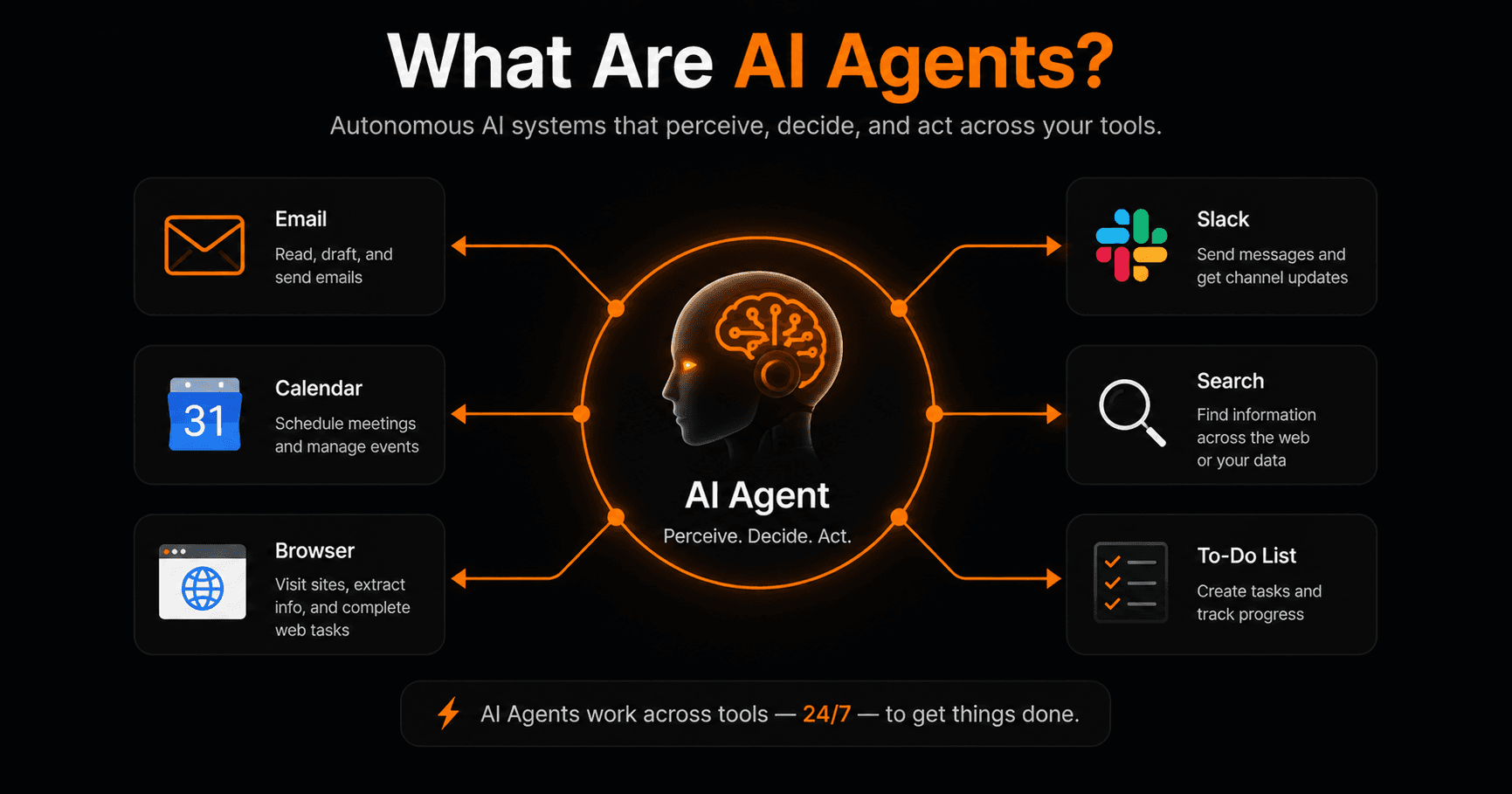
“AI agent” is one of the most overused phrases in tech right now — and also one of the most genuinely important concepts. Here's a plain English explanation of what AI agents actually are, how they differ from chatbots and basic automation, and what they can do for your business today.
Already comfortable with the basics? Jump straight to how to build a multi-agent AI pipeline or see what's actually possible with AI automation in 2026.
The simplest definition
An AI agent is a system that can perceive its environment, make decisions, and take actions — autonomously, across multiple steps, to achieve a goal you give it.
That's the key word: actions. A chatbot answers questions. An AI agent does things. It sends emails, searches the web, updates databases, calls APIs, books meetings, writes documents — and does all of this in a sequence, adapting based on what it finds along the way.
Chatbot vs AI agent — the real difference
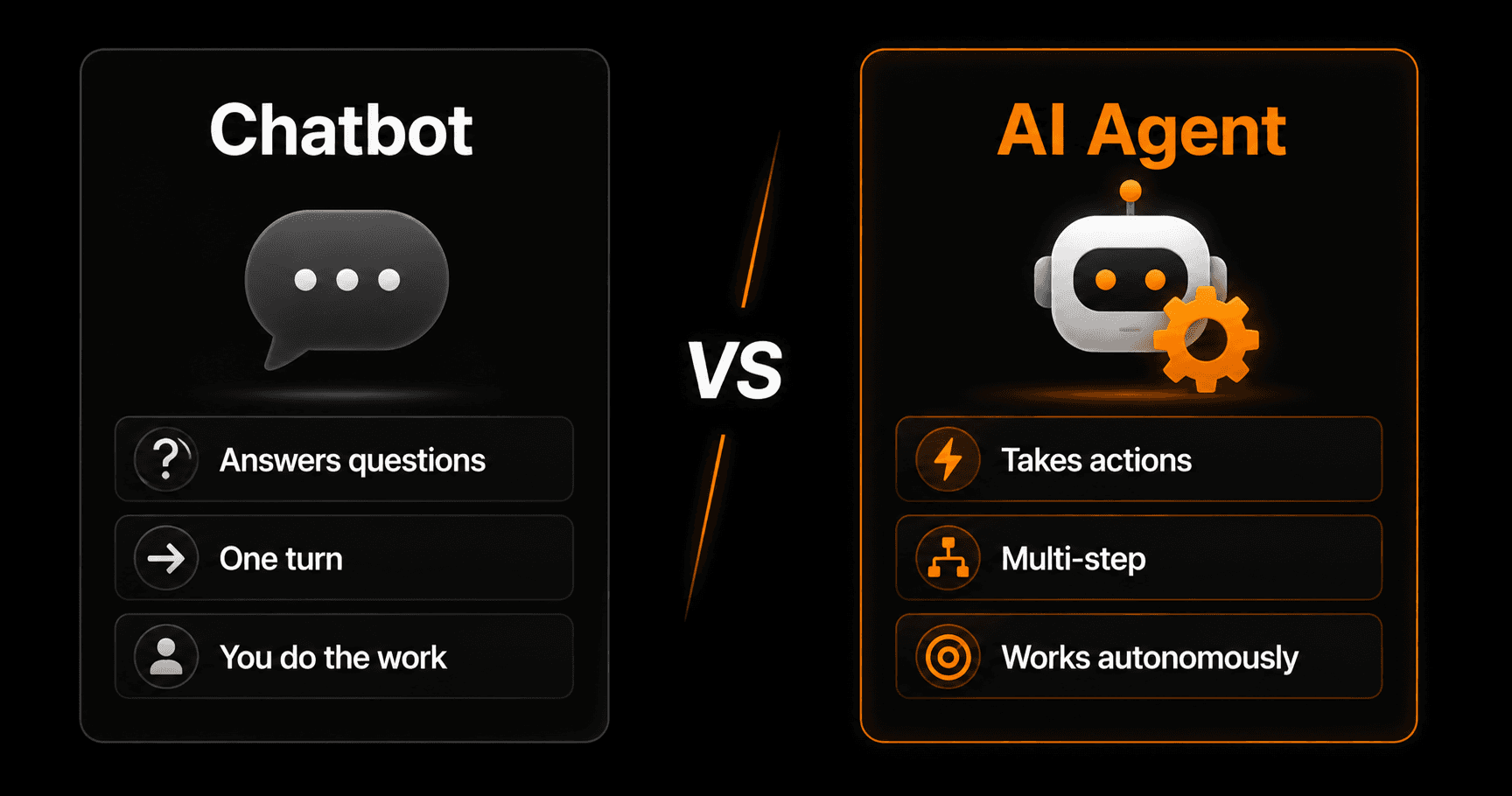
A chatbot responds. An AI agent acts.
The difference is not just capability — it's the fundamental model of how they work:
- Chatbot: You ask a question → it gives an answer → done. One turn. You still have to act on whatever it tells you.
- AI agent: You give it a goal → it breaks the goal into steps → it executes those steps → it reports back when done. Multi-step. It does the work.
Ask a chatbot “draft a follow-up email for my meeting with Sarah” and it writes text you then have to copy, paste, and send yourself. Give an AI agent the same goal and it pulls Sarah's contact from your CRM, drafts the email based on your meeting notes, and sends it — or queues it for your approval.
How AI agents actually work
Under the hood, an AI agent has three components:
- A brain (the LLM).A large language model like Gemini or GPT-4 handles all reasoning — deciding what steps to take, interpreting results, and adapting the plan when things don't go as expected.
- Tools. APIs and integrations the agent can call — Gmail, Slack, HubSpot, Google Search, a database, a browser. The agent decides which tool to use at each step.
- Memory.The ability to remember context across steps — what it found in step 1, what it sent in step 2, what the user said last time. Without memory, an agent can't handle multi-step tasks coherently.
The agent receives a goal, reasons about the best sequence of tool calls to achieve it, executes them one at a time (or in parallel), interprets the results, and either completes the task or asks for human input when it gets stuck.
Real examples of AI agents in 2026
Sales development agent
Goal: “Find 10 companies in the SaaS space with 50–200 employees who haven't used automation tools, research each one, and draft a personalised cold email for each.” The agent searches the web, pulls LinkedIn data, checks your CRM for existing contacts, researches each company, and writes 10 personalised emails — ready for your review.
Customer support agent
Goal: “Handle tier-1 support emails — answer common questions, look up order status, issue refunds under $50, and escalate anything else to the human team.” The agent reads incoming emails, classifies them, queries your order database, takes action where authorised, and escalates the rest.
Research agent
Goal: “Research our top 5 competitors — pricing, features, recent product updates, and customer sentiment. Compile a summary report.” The agent searches the web, reads pricing pages, scans review sites, and writes a structured competitive analysis in your Notion workspace.
Personal executive assistant agent
Goal: “Each morning, check my calendar for today's meetings, pull any relevant emails from those contacts, and prepare a briefing note with context for each meeting.” Runs automatically every morning at 7am.
What AI agents can't do (yet)
AI agents in 2026 are powerful but not infallible. They struggle with:
- Tasks requiring physical world interaction (beyond computer use)
- Long multi-day tasks without checkpoints — reliability degrades over very long chains
- Tasks requiring genuine creativity or strategic judgment (they follow patterns, not intuition)
- Anything requiring legal or financial accountability — a human still needs to be in the loop
The right model: think of an AI agent as an extremely capable junior assistant. It can handle most execution tasks, but you still want to define the goal clearly, check its work on high-stakes decisions, and keep humans accountable for outcomes.
AI agents on Vendarwon Flow
Vendarwon Flow lets you build AI agents by chaining AI nodes together in a workflow. Each node can call tools, use the output of previous steps, and branch based on what it finds. You describe the agent's goal in plain English and the platform builds the multi-step workflow automatically.
For complex agents that need memory across sessions, the Scale plan includes persistent agent memory — so your agent remembers previous interactions and builds context over time.
Frequently asked questions
Do I need to know how to code to build an AI agent?
Not on Vendarwon Flow. You describe the agent's goal and the tools it should have access to, and the platform builds the workflow. No coding required.
How is an AI agent different from a workflow automation?
Workflow automations follow a fixed path you define. AI agents reason about what to do next based on the current situation. An automation always takes the same steps; an agent adapts its steps based on what it finds.
Are AI agents safe to run autonomously?
For low-stakes tasks (research, drafting, logging), yes. For tasks with real-world consequences (sending emails, processing payments, deleting data), it's best to include a human approval step. Vendarwon Flow's approval node makes this easy — the agent pauses and waits for your sign-off before taking irreversible actions.
What's the difference between an AI agent and a bot?
A bot typically follows a script — a fixed set of rules. An AI agent reasons dynamically. A bot that handles support tickets routes them by keyword. An AI agent reads the ticket, understands the issue, checks your knowledge base, drafts a response, and only escalates if it can't resolve it confidently.