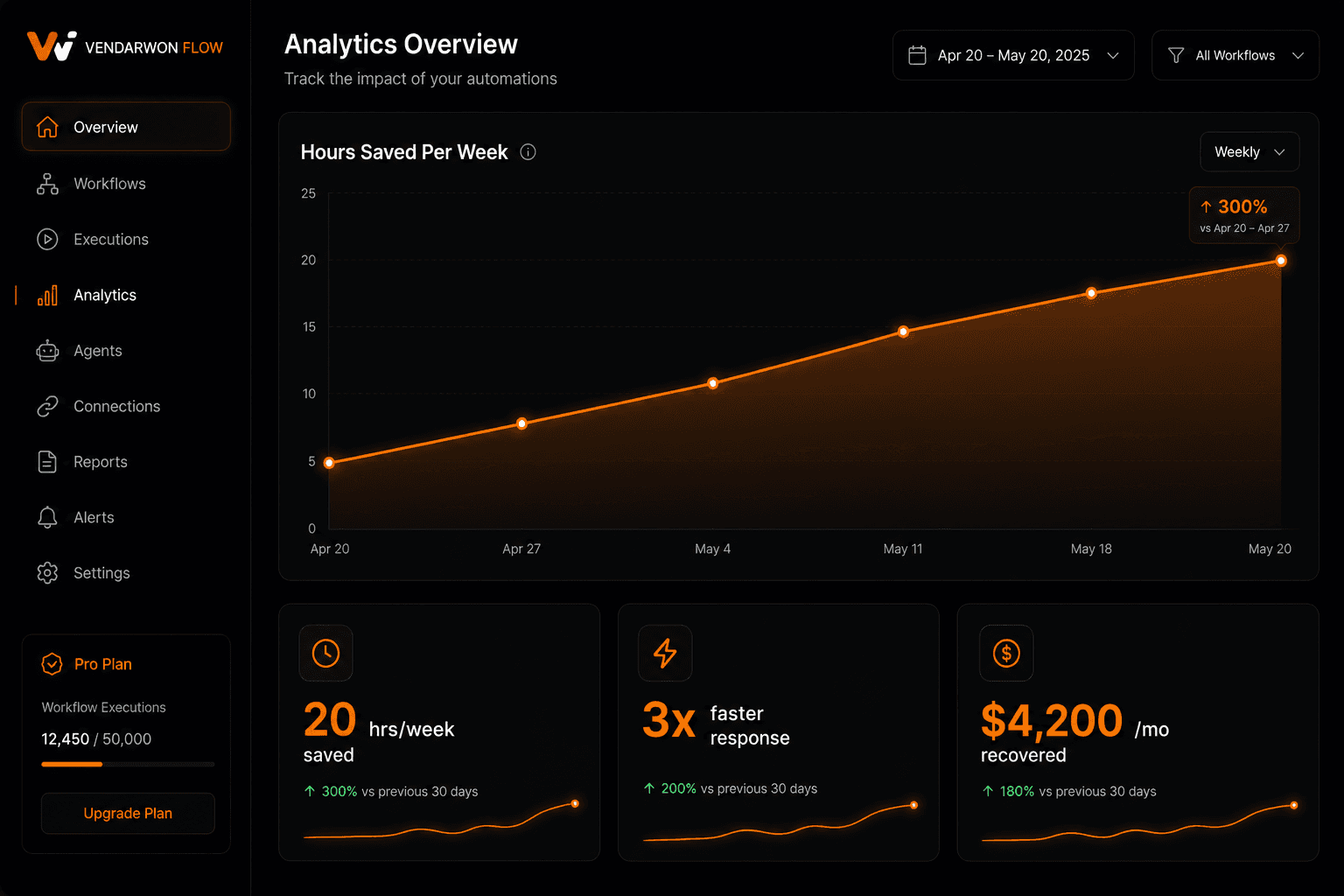
Everyone says automation “saves time” — but what does that actually mean in dollars? How do you calculate the ROI, build a business case, and know whether you're getting a fair return on your automation investment? This guide gives you the real numbers, a simple ROI formula, and a worked example of a company saving over $4,200 per month from a $29/month subscription.
The baseline: how much time does manual work actually cost?
Research from McKinsey, Salesforce, and Zapier consistently shows that knowledge workers spend 20–40% of their time on tasks that could be automated. For a 5-person business where each person earns $60,000/year, that's $60,000–$120,000 of labor cost per year doing work a computer could handle.
Even for a solo operator billing $75/hour, spending 10 hours/week on manual data entry, email sorting, and report generation costs $750/week — $3,000/month — in opportunity cost alone. That's time not spent on client work, sales, or product development.
The simple ROI formula
For individual automations:
Monthly ROI = (Hours saved/mo × Hourly rate) − Automation cost/mo
For a Gmail-to-HubSpot automation that saves 2 hours/month for someone billing $80/hour:
(2 × $80) − $9 = $151/month net return from the first month
Annualized: $1,812 return on $108 investment = 16.8× ROI
Real example: a 5-person marketing agency saves $4,200/month
A boutique marketing agency with 5 staff members and $150,000 annual revenue built these 6 automations on Vendarwon Flow's Growth plan ($29/month):
- Lead triage + CRM entry: Saves 1.5 hrs/week across the team = 6 hrs/mo saved at $65/hr avg = $390/mo
- Client report generation: Saves 4 hrs/week = 16 hrs/mo at $65/hr = $1,040/mo
- Email to Slack routing: Reduces email checking time — saves 1 hr/week/person = 20 hrs/mo = $1,300/mo
- Invoice generation: Saves 2 hrs/month = $130/mo
- Social media monitoring: Saves 3 hrs/month = $195/mo
- Contract renewal reminders: Prevented 2 missed renewals × $600 avg contract = $1,200/mo in retained revenue
Total monthly value: $4,255
Monthly cost: $29
Net ROI: $4,226/month = 145× return
5 KPIs to measure automation ROI
1. Time saved per week
Track how many hours of manual work each automation replaces. Compare time spent before vs after. Even rough estimates (based on how often the trigger fires × how long the task used to take manually) give you a meaningful baseline.
2. Error rate reduction
Manual work introduces human error. Data entry mistakes, missed CRM updates, wrong email recipients. Measure error rates before and after automating key processes. In most cases, error rates drop to near zero.
3. Response time improvement
How long does it take to respond to a new lead, answer a support ticket, or fulfill a request? Automation typically reduces this from hours to seconds. Measure average response time before and after.
4. Leads converted
Speed of response is one of the biggest predictors of lead conversion. Leads contacted within 5 minutes are 9× more likely to convert than leads contacted after 30 minutes. Track lead-to-conversion rate before and after implementing automated lead response.
5. Cost per task
What does it cost to complete a task manually vs automatically? Divide your automation plan cost by the number of tasks handled per month. At the Growth plan: $29/10,000 executions = $0.003 per task. Manual equivalent at $20/hour for a 5-minute task: $1.67 per task. Automation is 557× cheaper per task.
Building a business case for your boss
If you need to justify automation investment internally:
- List 3–5 specific manual processes you want to automate
- Estimate time spent on each per month (hours)
- Multiply by loaded labor cost (salary + benefits ÷ 2080 working hours)
- Total the monthly labor cost across all processes
- Compare to automation plan cost
- State break-even timeline (usually under 1 week)
Most automation investments break even within the first month and deliver 10–100× ROI annually. The math is hard to argue with.
Start measuring your automation ROI
Build your first AI workflow free on Vendarwon Flow. Track time saved in the first week — most users see a positive ROI within days.
Start building →