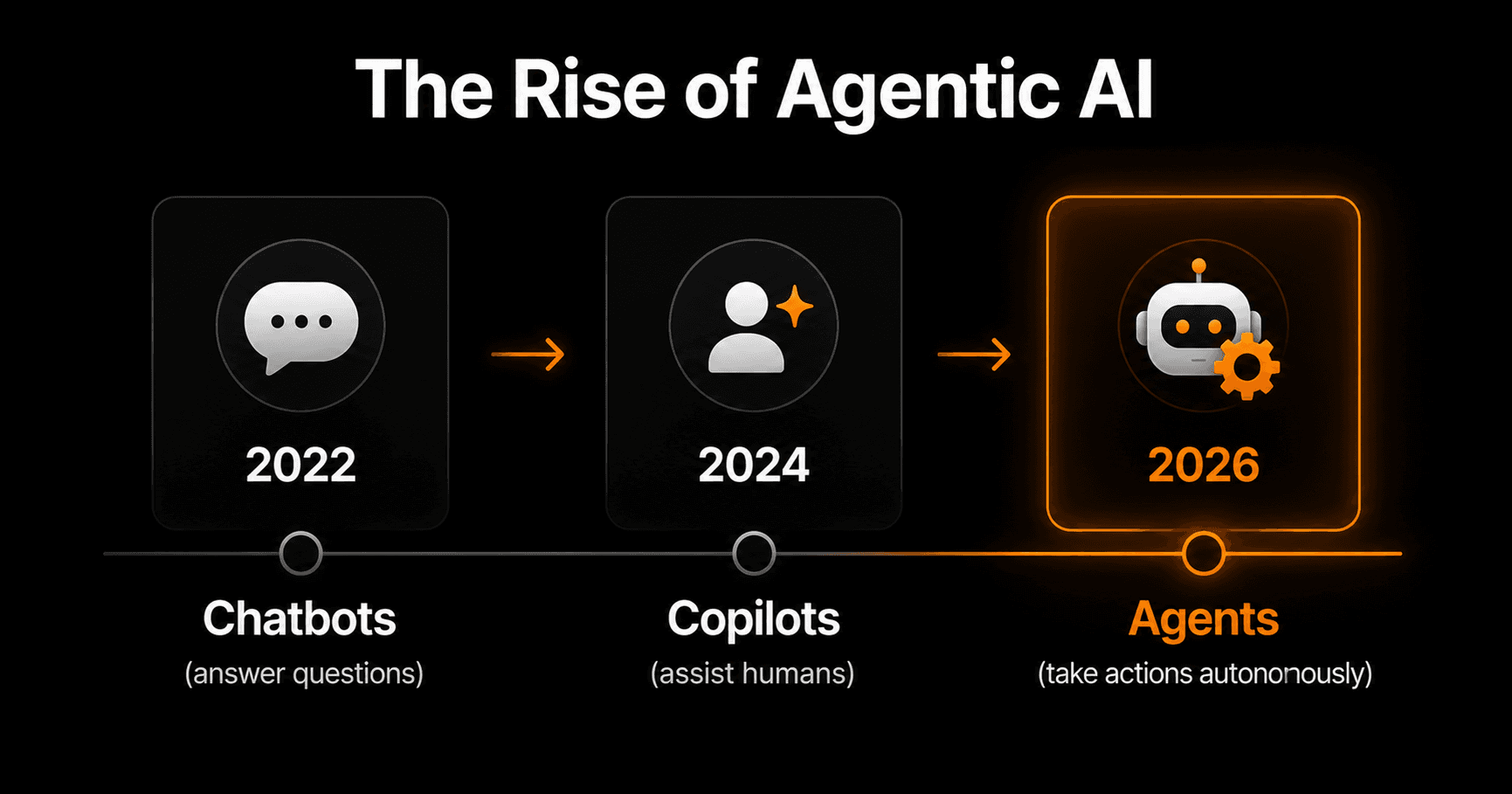
For three years, AI meant chatbots — tools that answer questions. Then it meant copilots — tools that assist humans with tasks. Now it means agents — systems that take actions autonomously, end to end, without waiting for a human at each step. That shift is the biggest change in how businesses operate since the internet.
The three eras of AI
Era 1: Chatbots (2022–2023)
AI that responds. You ask a question, it gives an answer. The human still has to decide what to do with that answer and take every action manually. Useful for lookup and drafting, but fundamentally passive.
Era 2: Copilots (2024–2025)
AI that assists. GitHub Copilot, Microsoft Copilot, AI writing tools — these reduce the friction of a specific task but still require a human to initiate, review, and complete every step. The AI is a very smart autocomplete.
Era 3: Agents (2026)
AI that acts. You give an agent a goal. It breaks the goal into steps, executes them using tools (APIs, apps, the web), handles unexpected situations, and reports back when done — or asks for human input only when it genuinely needs it. The human defines the goal; the agent handles execution.
This is the shift that changes everything. Copilots make individuals faster. Agents let small teams operate at the scale of large ones.
What agentic AI looks like in practice
The difference between copilot and agentic AI isn't subtle — it's the difference between a tool that helps you write an email and a system that manages your entire communication pipeline.
- Copilot: Suggests a reply to this email → you edit and send
- Agent: Monitors your inbox, classifies every email, drafts responses for routine inquiries and sends them, escalates complex issues to you with context, logs everything to CRM — all automatically
The agent doesn't just help with one email. It handles the whole process.
What it means for each part of your business
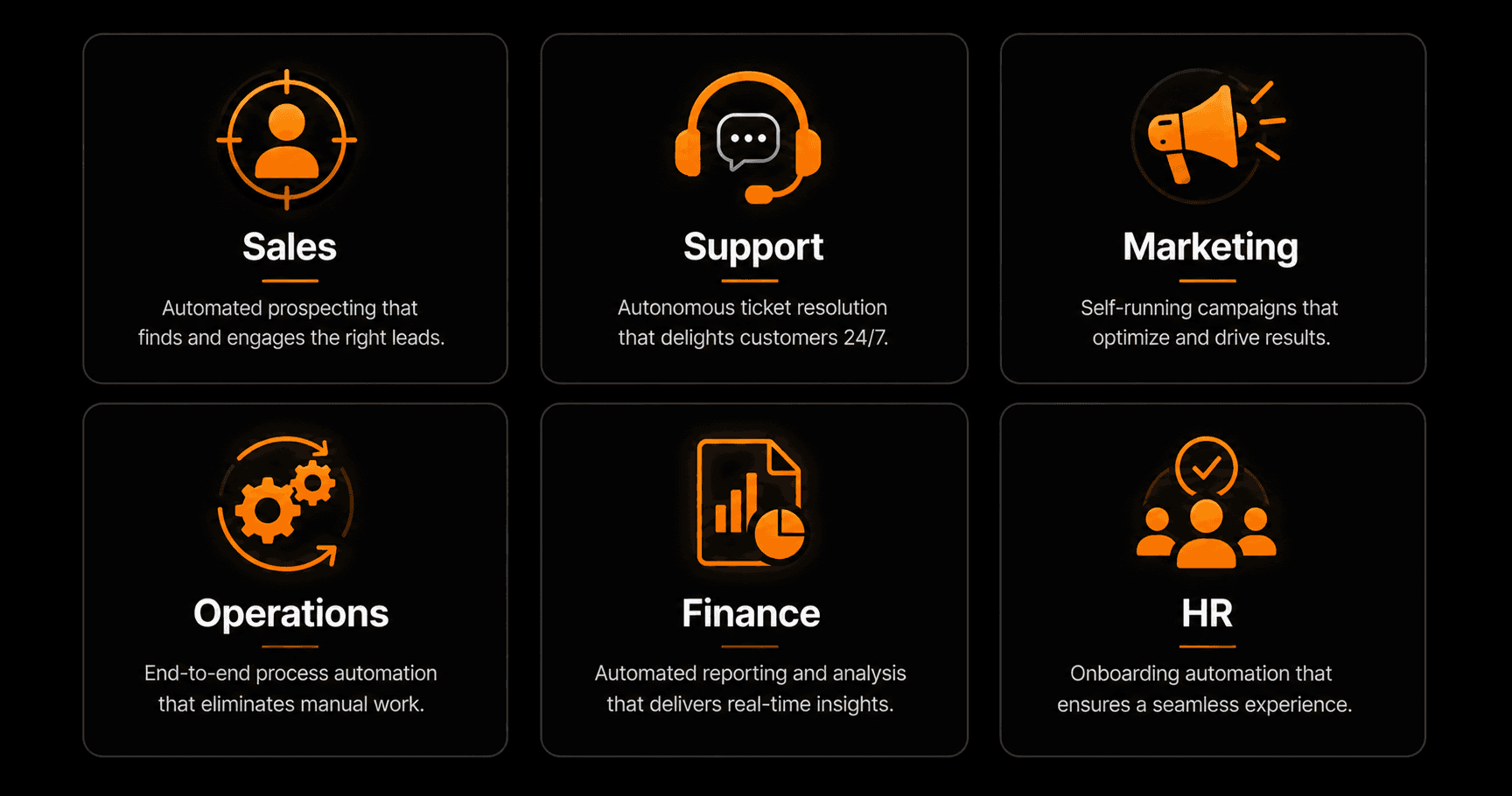
Every business function is being reshaped by agentic AI — here's what that looks like.
Sales
Agentic AI handles prospecting — researching leads, personalising outreach, following up on no-responses, updating CRM after calls, and flagging deal risks. Sales reps focus on relationships and closing. Everything else runs automatically.
Support
Support agents resolve tier-1 tickets autonomously — reading the issue, checking the knowledge base, crafting a response, sending it, and only escalating if confidence is below a threshold. Resolution rates of 40–60% without human involvement are already achievable in 2026.
Marketing
Marketing agents monitor performance, adjust campaign targeting, draft and schedule content, track competitor moves, and generate weekly performance summaries. Campaigns that used to require a team to manage now run largely on autopilot.
Operations
End-to-end process automation — from order receipt through fulfillment, invoicing, and reconciliation — with agents handling exceptions and flagging anomalies that need human review. Operational efficiency gains of 30–50% are common for businesses that deploy agents across core processes.
Finance
Automated reporting that pulls data from every source, detects anomalies, flags unusual transactions, and generates weekly P&L summaries without human data compilation. Finance teams shift from building reports to interpreting them.
HR
Onboarding agents handle the entire new hire sequence — sending documentation, creating accounts, scheduling introductions, tracking completion — so HR teams focus on culture and people, not admin.
The risks of agentic AI — and how to manage them
More autonomy means more potential for consequential errors. The key principles for deploying agentic AI safely:
- Human approval for irreversible actions. Sending mass emails, deleting records, processing refunds — these should require human sign-off. Use approval nodes in your workflow.
- Start narrow, expand gradually. Deploy agents on one process at a time. Prove reliability before expanding scope.
- Log everything. Every agent action should be logged with enough context to audit what happened and why.
- Set clear boundaries. Define what tools the agent has access to. An agent that can read emails doesn't necessarily need to send them — grant permissions incrementally.
How to get started with agentic AI today
You don't need to deploy agents across your entire business at once. Start with one process that has clear inputs and outputs, doesn't involve irreversible high-stakes actions, and currently consumes significant time.
Good starting points: email triage, lead qualification, weekly report generation, support ticket classification. Build one agent, run it for two weeks, measure the result. The evidence will make the case for expanding from there.
On Vendarwon Flow, you build agentic workflows by describing the goal in plain English. The platform generates the multi-step workflow with AI nodes, tool connections, and routing logic. You can be running your first agent in under 30 minutes.
Frequently asked questions
Is agentic AI ready for small businesses or just enterprises?
Agentic AI is arguably more valuable for small businesses — a 3-person team with agents running their email, CRM, and reporting operates with the output of a 6-person team. Large enterprises have more resources to compensate for manual processes; small teams don't.
What happens when an agent makes a mistake?
Good agent architecture includes error handling and human escalation. Design your agents to flag low-confidence situations rather than proceeding. For consequential actions, always include a human approval step. Mistakes happen — the goal is to contain their scope.
How is this different from the automation that's existed for years?
Traditional automation follows rules you define. Agentic AI reasons about what to do based on the situation. Traditional automation breaks when inputs are unexpected. Agents adapt. The capability gap is enormous — agentic AI can handle tasks that rule-based automation can't even attempt.
Do I need to understand AI to use agentic workflows?
No. On Vendarwon Flow, you describe what you want the agent to do and the platform handles all the technical implementation. Understanding the underlying model is no more necessary than understanding TCP/IP to send an email.