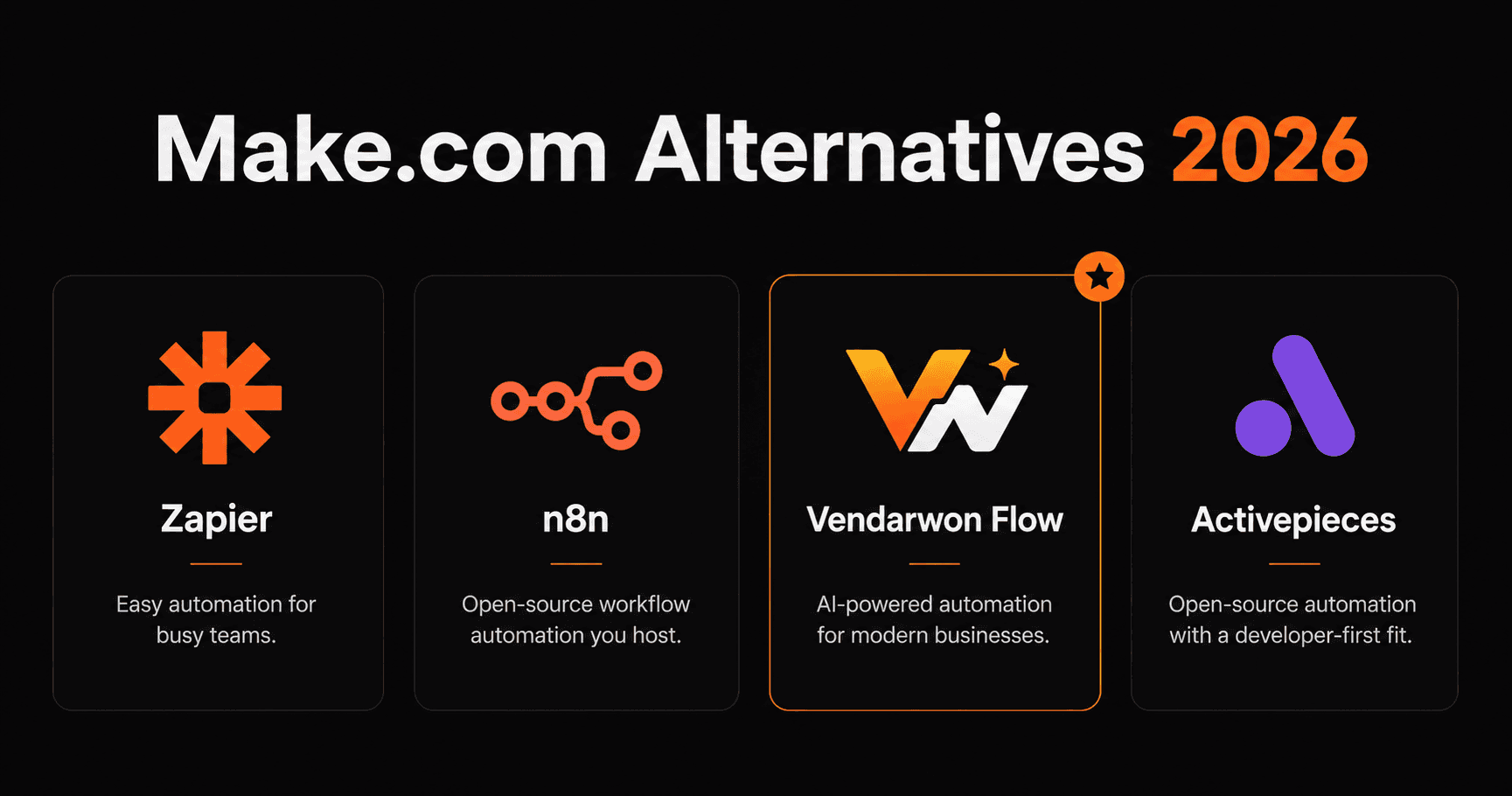
Make.com is a powerful automation platform — but it's not right for everyone. Whether you hit the pricing ceiling, found the learning curve too steep, or just want to explore what else is out there, here's an honest look at the best Make alternatives in 2026.
Why people look for Make alternatives
Make (formerly Integromat) is genuinely capable software. But the most common complaints that send users searching for alternatives are:
- The visual node editor is powerful but overwhelming for non-technical users
- Concepts like “bundles”, “iterators”, and “aggregators” have a steep learning curve
- Operations-based pricing gets expensive fast at high volume
- No native AI workflow nodes — AI requires custom API calls
- Support quality varies, especially on lower-tier plans
If any of these sound familiar, one of the alternatives below will likely be a better fit.
The top 4 Make alternatives in 2026
1. Vendarwon Flow — best for AI-powered automation without a learning curve
Vendarwon Flow takes the opposite approach to Make: instead of a visual node editor you configure manually, you describe your workflow in plain English and AI builds it for you. The entire workflow — including conditions, branches, loops, and AI nodes — is generated in seconds.
What sets Vendarwon Flow apart is native AI integration. Every workflow can include Gemini-powered AI nodes for classification, lead scoring, content generation, summarization, and more — without writing code or calling APIs manually. For teams that want intelligent automation (not just data piping), this is a significant advantage.
- Best for: Non-technical users, AI workflows, fast iteration
- Pricing: Free (100 executions/month), $9–$99/month paid
- Free plan: Yes — AI nodes included
- Self-host: No (cloud only)
2. Zapier — best for simplicity and the largest app library
Zapier is the oldest and most widely known automation platform. It has 6,000+ app integrations — more than any competitor — and its two-step “Zaps” are genuinely easy to set up. If your workflow is simple (trigger → single action) and your app is only on Zapier, it's hard to argue with.
The downsides: multi-step workflows feel clunky, pricing escalates quickly, and there's no native AI. But for straightforward automations where breadth of integrations matters most, Zapier still leads.
- Best for: Simple automations, niche app integrations
- Pricing: Free (100 tasks), $19.99+/month paid
- Free plan: Very limited
- Self-host: No
3. n8n — best for developers who want full control
n8n is open-source and free to self-host. If you have a server and DevOps knowledge, you can run unlimited workflows with no usage fees. The node editor is similar to Make but more developer-friendly, with support for custom JavaScript in any step.
The catch is the self-hosting overhead — setup, maintenance, uptime, and updates are all your responsibility. n8n also has a cloud plan, but at that point the cost advantage over Make disappears.
- Best for: Developers, self-hosters, high-volume at low cost
- Pricing: Free (self-hosted), $20+/month cloud
- Free plan: Self-hosted only
- Self-host: Yes
4. Activepieces — best open-source Make alternative
Activepieces is an open-source automation platform that looks and feels similar to Make but with a cleaner interface. It's actively developed, growing its integration library, and offers both a self-hosted and cloud version.
It's a good choice for developer teams who want the flexibility of open-source but prefer a more polished UI than n8n. The integration count is smaller than Make or Zapier but growing fast.
- Best for: Developer teams wanting open-source with good UX
- Pricing: Free (self-hosted), cloud plans available
- Free plan: Self-hosted
- Self-host: Yes
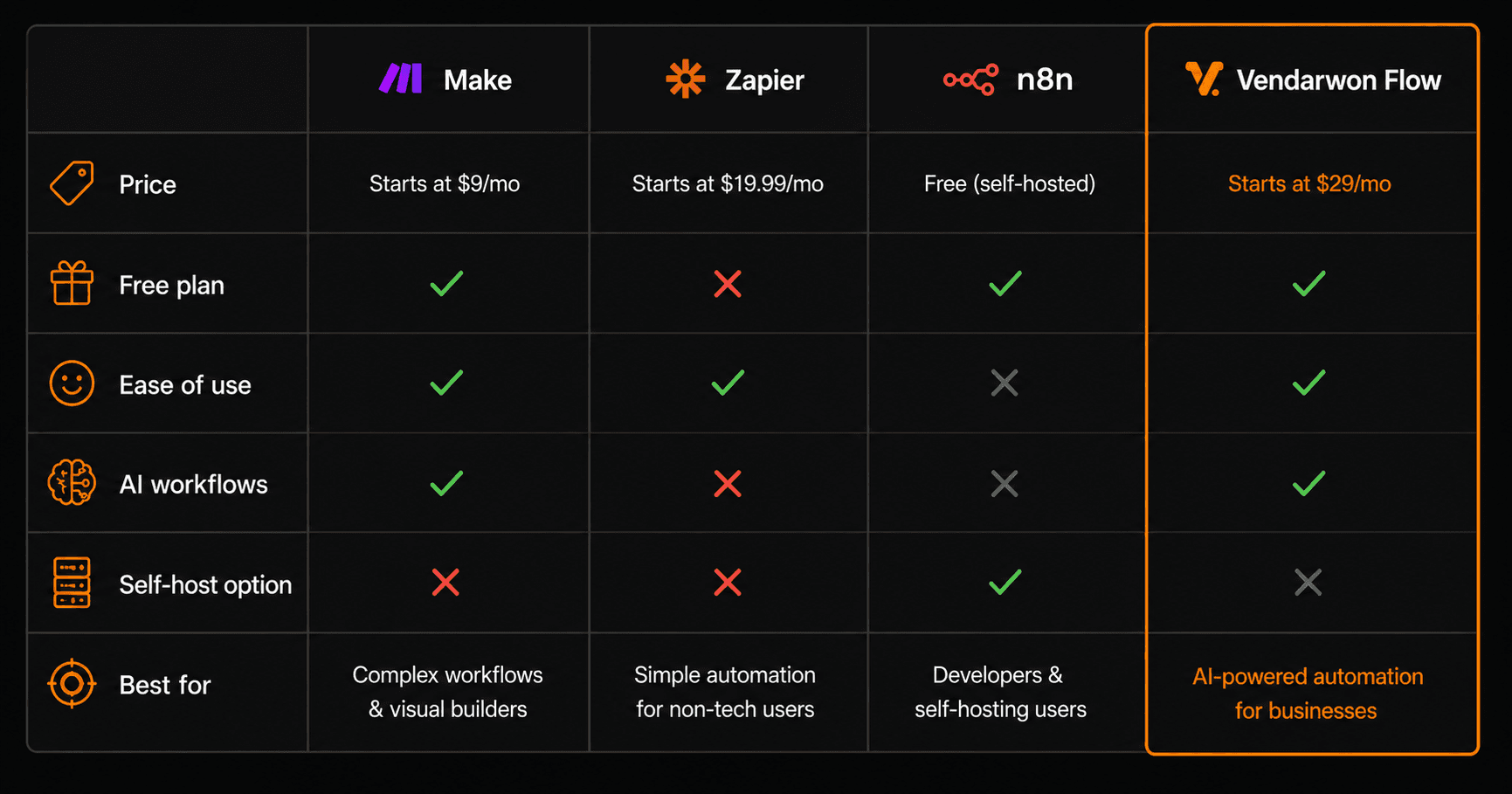
Side-by-side comparison: Make vs its top alternatives across price, AI, ease of use, and more.
Which Make alternative should you choose?
If you left Make because of complexity
Try Vendarwon Flow. The AI-generated workflow builder eliminates configuration entirely — you describe what you want and it's built for you. No bundles, no iterators, no node mapping.
If you left Make because of price
Try n8n (self-hosted) if you have technical capacity — the software cost is zero. Or try Vendarwon Flow's $9/month Starter plan, which covers 2,000 executions and all features including AI nodes.
If you left Make because you need more integrations
Try Zapier — 6,000+ integrations is genuinely its superpower. If your app is only available on Zapier, that may be the deciding factor.
If you want open-source with a better UX than n8n
Try Activepieces — it's the most Make-like experience in the open-source space, with an actively growing community.
Frequently asked questions
Is there a direct Make.com competitor with better pricing?
Vendarwon Flow's $9/month Starter plan and n8n's free self-hosted option are both significantly cheaper than Make at equivalent usage volumes. Vendarwon Flow also includes AI nodes that Make charges extra to approximate via API calls.
Can I export my Make scenarios and import them elsewhere?
Make exports scenarios as JSON. Most platforms can't import Make's format directly, but you can describe your existing workflows in plain English on Vendarwon Flow and the AI will recreate them.
Which alternative has the most integrations?
Zapier leads with 6,000+. Make has 1,000+. Vendarwon Flow has 42+ focused integrations plus HTTP Request for any app with an API. n8n has 400+.
Is Vendarwon Flow a good replacement for Make for complex workflows?
Yes — Vendarwon Flow supports conditions, loops, error handling, human approval steps, delays, and multi-branch logic. The AI builds these automatically when you describe what you need. For AI-enhanced workflows specifically, it's more capable than Make out of the box.