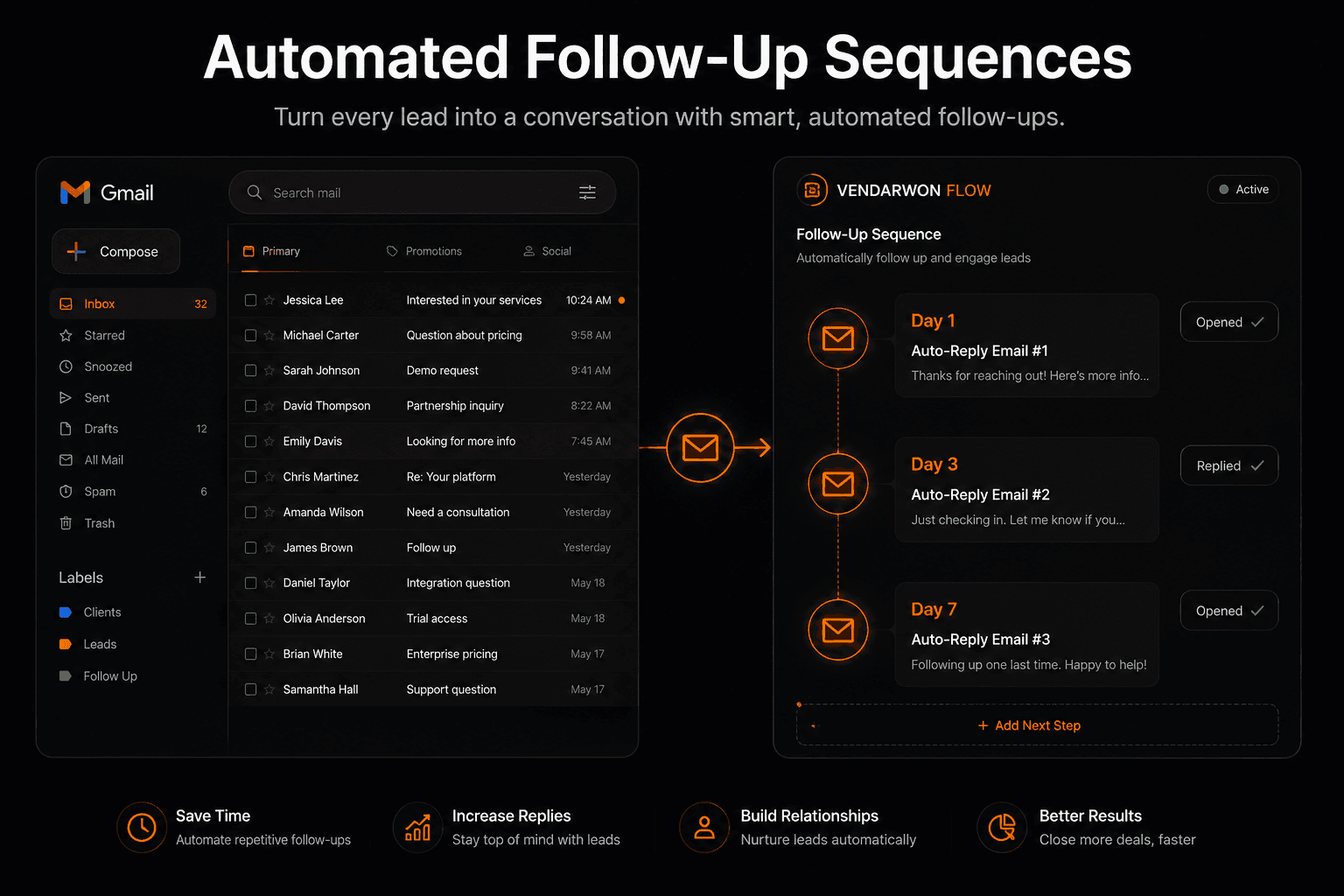
Most sales follow-up emails fail not because the product is wrong or the price is too high — they fail because the rep sends one email and gives up, or sends three emails that all say the same thing. Automated follow-up sequences fix both problems: they're persistent, perfectly timed, and — when built right — feel genuinely personal despite running without human input.
Why most follow-up emails fail
The data on follow-up is brutal. 80% of sales require at least five follow-up touches. Yet 44% of reps give up after just one. The gap between what's required and what actually happens is where deals die.
Manual follow-up fails for predictable reasons: reps get busy, forget, don't have a system, or feel awkward about “bugging” a prospect. Automation removes all three barriers. The sequence runs regardless of what else is happening, and the timing is calibrated for conversion — not human comfort.
The other failure mode is generic messaging. When every follow-up says “Just checking in — any thoughts?”, prospects tune out immediately. AI-powered sequences personalize each email based on lead context: their company, role, industry, and the specific pain point that brought them to you.
The 3-touch sequence that converts
The most effective automated follow-up sequences use three touches spaced across the first week of contact. Here's the structure:
Day 1 — Value delivery
Send within an hour of the initial contact. This email doesn't ask for anything — it delivers something useful. A relevant case study, a one-paragraph summary of how you've solved their specific problem for similar companies, or a short video walkthrough. The AI personalizes the case study reference and opening line based on the lead's company and role.
Subject line formula: [Company name] — how [similar company] solved [specific problem]
Day 3 — Soft ask
If no reply to the Day 1 email, send a second touch that makes a low-friction ask. Not “are you ready to buy” — something they can respond to in under 30 seconds. “Would a 15-minute call next week make sense?” or “Is [specific problem] still on your radar?”
The AI references something from their original inquiry or company context to show this is't a mass email — it's relevant to them specifically.
Day 7 — Breakup email
If still no reply, send the breakup. This is counterintuitively the highest-response email in the sequence. Tell them you won't follow up again and give them one last easy way to re-engage. “I'll take your silence as a no for now — if timing changes, here's my calendar link. Good luck with [their project/goal].”
Breakup emails get replies because prospects feel the door is about to close. Response rates on Day 7 breakups are often 2–3x higher than Day 3 follow-ups.
Manual vs automated follow-up — the numbers
| Metric | Manual Follow-Up | Automated Sequence |
|---|---|---|
| Average touches per lead | 1.3 | 3 (100% of the time) |
| Time per lead (rep time) | 8–12 min | <1 min (review only) |
| Leads that get followed up | ~60% | 100% |
| Average open rate | 18–22% | 28–40% (personalized) |
| Reply rate | 3–6% | 8–15% |
| Leads that fall through the cracks | ~40% | 0% |
How AI personalizes at scale
The key to automated follow-ups that don't sound robotic is AI personalization at the node level. In Vendarwon Flow, before each email is sent, an AI node reads the lead context — their company name, job title, the product they inquired about, and any prior email content — and rewrites the opening two sentences of each email to feel specific to them.
Instead of: “Hi [First Name], just following up on my last email...”
The AI writes: “Hi Sarah — given that Acme is scaling its outbound team, I thought the case study on how TechCorp cut lead response time by 60% might be worth 5 minutes of your time.”
This level of personalization at scale is only possible with AI. A human rep could write it — but not for 200 leads simultaneously.
Building the sequence on Vendarwon Flow
In Vendarwon Flow, the entire three-touch sequence is built as a single workflow:
- Trigger: New lead arrives (webhook from your form, CRM contact created, or email received)
- AI node: Reads lead context, personalizes the Day 1 email body
- Action: Send Day 1 email via Gmail or Resend
- Delay node: Wait 3 days
- Condition: Did they reply? (check CRM activity)
- Branch — No reply: AI personalizes Day 3 email → send
- Delay node: Wait 4 more days
- Condition: Did they reply?
- Branch — No reply: Send Day 7 breakup email
- Branch — Replied: Create follow-up task in CRM, alert rep in Slack
You describe this in plain English and Vendarwon Flow generates the entire workflow. The delay nodes pause execution without consuming compute, so the sequence runs correctly even across weekends and holidays.
Tips for maintaining a human tone
- Keep emails short. Three to five sentences max. Prospects delete long emails. They reply to short ones.
- One ask per email. Never ask for multiple things. Pick the single most important next step.
- No marketing language. Avoid words like “leverage,” “synergize,” or “circle back.” Write the way a real person texts.
- Reference something specific. Use the AI node to pull in one fact about their company or role. Specificity signals that the email isn't a blast.
- Send from a real person. Automated emails that come from a named rep outperform those sent from generic info@ addresses by a significant margin.
Open rate benchmarks for 2026
Cold outreach open rates have declined industry-wide as inbox filters have improved. But personalized, contextual follow-up from a known sender still performs well:
- Generic bulk follow-up: 15–20% open rate
- Personalized automated sequence (role + company): 28–38% open rate
- AI-personalized with behavioral trigger (email opened, pricing page visited): 40–55% open rate
When to stop following up
After the three-touch sequence, stop active follow-up. Add the lead to a long-term nurture sequence — monthly value emails, product updates, relevant content — that keeps you on their radar without being pushy. Most B2B buying decisions have a 3–12 month cycle. A lead who goes cold today may be your customer in six months if you stay visible.
Vendarwon Flow handles this automatically: the breakup email branch routes non-responders into a monthly newsletter workflow, so you never fully lose a lead — you just adjust the frequency.
Build your follow-up sequence in minutes
Describe your 3-touch sequence in plain English and Vendarwon Flow builds the full workflow — AI personalization, delay nodes, reply detection, and CRM sync included. Free plan available.
Start building →